One of the exclusive features offered to students of the
Renaissance series is the opportunity to receive snippets of lesser-known
historical information. These
revelations were thanks to Alan Pascuzzi, Frank Nero, Jeremy Boudreau, Angela
Oberer and Susan Madocks Lister who together made the ‘Dawn of the Renaissance’
course an educationally stimulating month.
As a group we focused in depth upon broad aspects of Italian art before
1400, from Giotto to Simone Martini, attending visits to Santa Maria del Fiore,
Santa Maria Novella and the Uffizi, amongst other renowned sites.
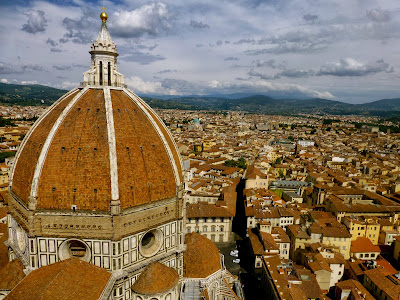 |
A View of Florence and Brunelleschi's famous dome from the top of
the Santa Maria del Fiore Bell Tower. |
Throughout lectures and tours our eyes were opened to the
anecdotes and momentous narratives embedded within Florence’s artistic
framework.
 |
Students on the ‘Dawn of the Renaissance’ course on the steps of the
Loggia dei Lanzi with the Palazzo Vecchio and (second) David firmly
in sight! During this tour with Alan Pascuzzi we discovered that
hidden beneath the concrete floors of the Piazza della Signoria there
is an ancient Roman city simply waiting to be uncovered.
|
…Who knew that the dents in the wall of the Loggia dei Lanzi
were the result of artists’ leisurely (and probably wine-fuelled!) shooting
games?
 |
| Visible shot marks in the walls of the Loggia dei Lanzi. |
One of the most resounding anecdotes of the ‘Dawn of the
Renaissance’ was the tale of Antonio Rinaldeschi. Our lecturer, Frank Nero, first introduced us
to this shady character on our ‘Guelf and Ghibelline’ walking tour where we
visited Santa Margherita de’Cherchi, Santi Apostoli and Santa Maria
de’Ricci. The last of these churches is
the site in which Antonio, a “nobleman”, flung a handful of manure at an Annunciation
altarpiece of the Virgin. He committed
this atrocity in a drunken rage after loosing a hefty portion of money (and
clothing!) whilst gambling at the Osteria del Fico.
 |
A scene representing Antonio Rinaldeschi before the pivotal
moment, dung in hand. This image is a close-up taken from
Filippo Dolciati's nine panel narrative now displayed in the
Museo Stibbert.
|
Here a contemporary recounts the crime,
‘he gathered horse
dung from the ground, and guided by a diabolical force…threw it at the face of
said figure of the virgin mother Mary, and part of said dung “remained stuck in
the diadem”…to her great dishonour and disgrace and to the shame of Christian
faith.’
(William J. Connell, Giles Constable, Sacrilege and Redemption in Renaissance Florence:
The Case of Antonio Rinaldeschi, p. 102).
 |
| Filippo Dolciati, The Story of Antonio Rinaldeschi, 1502, Museo Stibbert. |
Miraculously, and to the utter horror of Antonio, some of
the dung remained attached to the fresco forming a crown above the Madonna’s head. Taking this as a sign, the culprit fled, only
to be shortly arrested and tortured at the Bargello where he was subsequently
hung...
Clearly blasphemy did not go unpunished in early
sixteenth century Florence as emphasised through the immortalisation of Antonio's story by the painter Filippo Dolciati (above).
The Guido Riccio Controversy
 |
Possibly Simone Martini, possibly Duccio, Guido Riccio at the
Scene of Montemassi, possibly 1330, Palazzo Pubblico, Siena. |
During a lecture on the Sienese artist Simone Martini, Susan Madocks Lister enlightened us to the controversy surrounding this painting 'Guido Riccio at the Scene of Montemassi' (above). Commissioned in 1330, the artwork resides proudly on the walls of Siena's Palazzo Pubblico as a symbol of national triumph and historic power.
 |
Close-up of Guido Riccio on horseback. The diamonds
adorning this equestrian figure were originally silver
but have oxidised over time. |
 |
Close-up of the fresco overlapped by and hidden beneath
the later 'Guido Riccio' image. |
Art historian Gordon Moran initially recognised the ambiguity of the paintings' provenance after identifying a fresco hidden beneath the later, current image. This revelation evoked an anxious response resulting in the works' revised attribution. It is now ascribed to either Simone Martini or the Sienese master, Duccio. Who do you believe to be responsible for this (supposed) image of ‘Guido Riccio’, Martini, Duccio, neither or both?!
- Ellie Porter HOA Intern


